John Williams, and a team from the British Geological Survey (BGS), investigated the effects of pressure propagation during CO2 storage while part of the UKCCSRC core research programme during the period 2017-2022. This work has informed further studies to provide improved regional geological understanding that is highly relevant to today’s industry-led implementation of CO2 transport and storage infrastructure in the North Sea.
What was the issue your research sought to address?
To meet the UK’s emissions targets, a substantial amount of CO2 will need to be injected into subsurface reservoir rocks to avoid atmospheric emissions. Injecting CO2 into the subsurface will cause an increase in the pressure of fluids trapped within the rocks. Understanding how the resulting pressure wave travels through the rocks and the possible effects of increasing pressure in the subsurface are important to ensure the safe injection and containment of the CO2.
Our early work indicated that if injection sites are connected to large interconnected rock units, the pressure response might be felt over considerable distances. The large pore volume provides a means to effectively dissipate the pressure, enabling greater amounts of CO2 to be injected and stored. While this has been understood for some time, there has been growing concern that where several projects wish to make use of the same rock formation, potential conflicts could arise whereby the ‘pressure space’ available to one project could be partially used by another operator. The Bunter Sandstone of the North Sea is a good example where this potential issue has been raised, given that multiple carbon storage licences have been awarded. Using UKCCSRC funding, we set out to investigate this potential issue.
What did the UKCCSRC funding enable you to achieve?
Based on earlier modelling studies, we identified a number of geological uncertainties that could influence the pressure behaviour in the Bunter Sandstone, and commenced a series of studies to address them. These studies involved the collation, quality-control and interpretation of large-volumes of subsurface data, namely seismic and well data acquired during past oil and gas exploration and development activities.
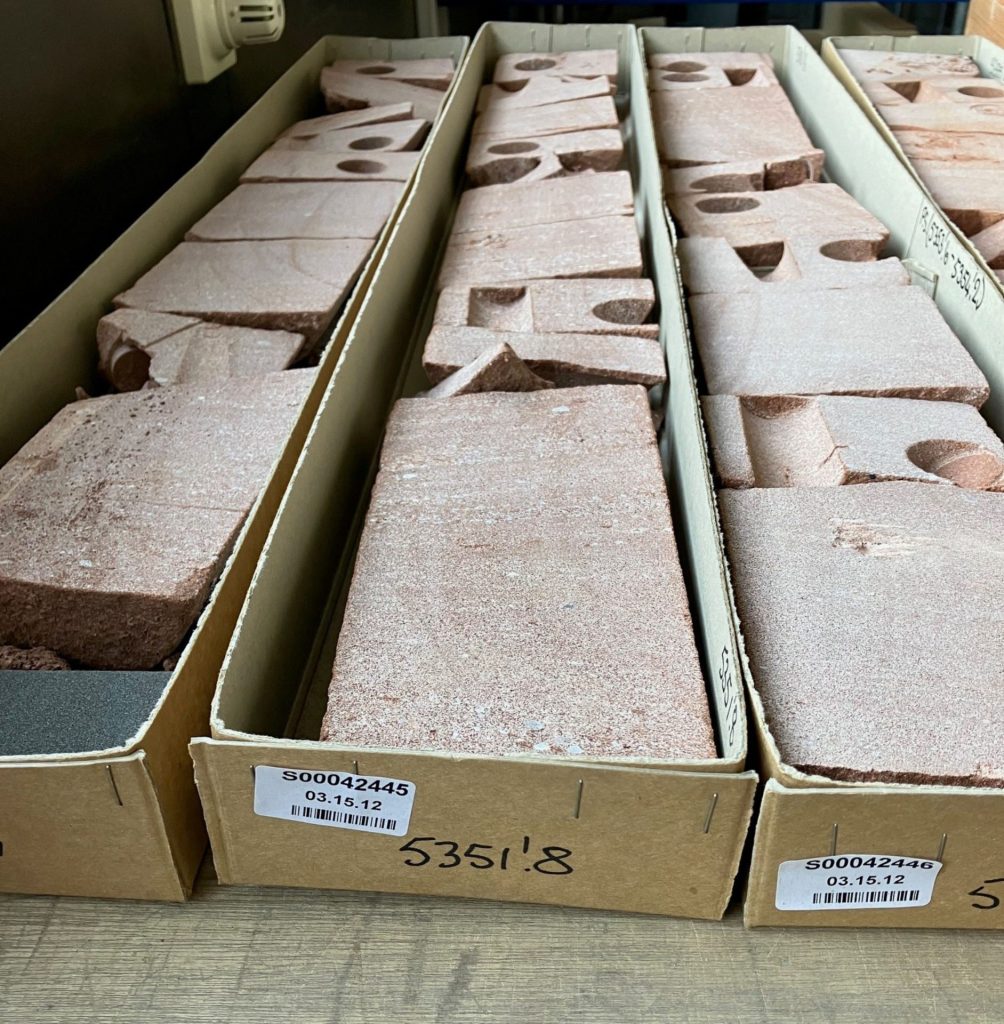
Bunter Sandstone rock cores collected during legacy oil and gas exploration activities are stored at the British Geological Survey’s National Geological Repository where they provide a valuable resource for CO2 storage assessments. Around two kilometres of core were studied thanks to UKCCSRC funding. BGS © UKRI 2026.
We used these data to better characterise a number of aspects, such as:
- The structural configuration of the subsurface to identify the size and extent of the interconnected rock units in the Bunter Sandstone.
- The depositional history of the Bunter Sandstone and its stratigraphic connectivity.
- The impact of post-burial processes on the properties of the reservoir rock materials.
- The extent and efficacy of the overlying sealing rocks.
- The geomechanical effects related to potential pressure increase.
How did you subsequently build on this work?
The initial findings and understanding we developed during the UKCCSRC project enabled us to identify some key research questions and to develop proof of concept. We then sought further funding from other sources to refine these ideas and to implement full interpretation and modelling studies. We received funding from the Industrial Decarbonisation and Innovation Centre (IDRIC) to further evaluate CO2 storage in the Bunter Sandstone. Using geological understanding developed during the UKCCSRC project, we built a three-dimensional geological model and conducted a numerical modelling exercise to simulate the pressure response to CO2 injection based on published industry storage scenarios.
The NERC-funded MOET project then provided an opportunity to disseminate the results more widely through a series of papers and published datasets. We also used the NERC funding to deliver an additional regional study focused on the Röt Halite Member, a halite (rock salt) unit which overlies much of the Bunter Sandstone. The unique properties of halite mean that the Röt Halite potentially provides a highly effective seal which would prevent CO2 from migrating upwards out from the intended storage formation. Understanding the properties and distribution of this rock unit is therefore a key consideration in CCS appraisal studies. In another piece of work, we built on our earlier numerical modelling work by incorporating geomechanical effects, providing insights into the rock deformation behaviour at the regional scale. Studies such as this are important as they provide insights into the likely behaviour of CO2 storage sites, helping to understand storage risks and to develop suitable monitoring strategies. Without access to the UKCCSRC funding, we would not have been in a position to develop strong proposals to fund the additional work required to complete these regional-scale studies.
With the first UK CCS projects in development, how do these regional geological studies fit into the industrial implementation picture?
Industry studies tend to focus on the risks associated with specific carbon storage licences, as required to navigate through the regulatory milestones needed to eventually obtain a permit to store CO2 in the subsurface. The advantage of research projects is that they can focus on the regional picture, independently of the specific needs of any individual carbon storage licence. The expectation is that this will in turn provide the licence operators with the understanding they need to place their own site appraisal studies into an appropriate regional context, while helping those companies and their regulatory agencies to better understand potential regional impacts.
The first Storage Permit for a UK Bunter Sandstone site was issued to the Northern Endurance Partnership (NEP) in December 2024, with the project now in construction with anticipated start-up within the next few years. As the project expands, and other licenced sites mature along their development pathways, the necessity of understanding rock properties and connectivity at the regional scale will be further enhanced.
What comes next?
To meet current climate targets, the UK needs a lot of CO2 storage – which will be challenging to implement given the scale-up required. The Bunter Sandstone is one very large and extensive rock formation that will accommodate some of the CO2, but we will need to develop other rock formations. Several rock units are being considered by industry consortia, but there are some units beneath the North Sea that offer a theoretically very large storage potential, yet remain relatively underexplored to date. Regional geological studies such as those we undertook for the Bunter Sandstone provide an excellent way to explore the challenges that will be faced when seeking to develop these reservoirs. Doing this in a pre-competitive manner through research-focused initiatives will provide stakeholders, including regulators and industries, with valuable information that will help to understand how to most effectively utilise the UK’s storage resources.

Seismic and well data are integrated in a 3D workstation environment to build 3D models for assessments of CO2 storage potential. BGS © UKRI 2026.
At BGS, we have been working towards this by conducting research focused on the Central North Sea, an area with enormous potential for CO2 storage, but not without its challenges. This initiative provides an ideal opportunity to implement the principles, methodologies and understanding developed during the UKCCSRC project.
Published results
Abel, L.E., Williams, J.D.O., Wright, K.A., Randles, T.A., Bridger, P., Morris, H.A., Dodd, T.J.H., Plenderleith, G.E., White, J.C. 2025. Structural controls on pressure communication across the Bunter Sandstone Formation, UK Southern North Sea. Geoenergy, 3, geoenergy2024-027. https://doi.org/10.1144/geoenergy2024-027
Graham, R., Williams, J., Purvis, S., Parsons, R. 2025. Stratigraphic and Sedimentological Evolution of the Bunter Sandstone Formation, UK Southern North Sea: Implications for CCS. Sixth EAGE Global Energy Transition Conference & Exhibition (GET 2025), Oct 2025. https://doi.org/10.3997/2214-4609.202521059
Morris, H.A., Williams, J.D.O., Abel, L.E., Hough, E., Field, L.P., Parsons, R. 2026. Evaluation of the Röt Halite Member as a top seal for carbon dioxide storage in the Southern North Sea. Geoenergy, 4, geoenergy2025-029. https://doi.org/10.1144/geoenergy2025-029
Rushton, J.C., Hannis, S., Pearce, J., Williams, J., Milodowski, A.E. 2025. Diagenetic evolution of the Bunter Sandstone Formation and its controls on reservoir quality: implications for CO2 injectivity and storage. Geoenergy, 3, geoenergy2024-023. https://doi.org/10.1144/geoenergy2024-023
Williams, J.D.O. 2025. Pore pressure data from the Bunter Sandstone Formation, Southern North Sea of the UK Continental Shelf. NERC EDS National Geoscience Data Centre. (Dataset). https://doi.org/10.5285/530ccd12-bfca-4112-b25c-e8c929f74964
Case studies Flexible Funding ImpactRecent Posts:
- 10 December 2025
- 19 September 2024
- 29 August 2024
The UK Carbon Capture and Storage Research Community (UKCCSRC) is supported by the Engineering and Physical Sciences Research Council (EPSRC) as part of the UK Research and Innovation (UKRI) Energy Programme.


The mission of the UKCCSRC is to ensure that carbon capture and storage (CCS) plays an effective role in helping the UK achieve net-zero greenhouse gas emissions by 2050.
Location
D03 Ella Armitage Building
University of Sheffield
40 Leavygreave Road
Sheffield
S3 7RD
UK
Social
