
Professor Sophie Nixon and Dr Leanne Walker, at the University of Manchester, were awarded UKCCSRC Flexible Funding in 2023 for research into “Microbiological response to geological CO2 storage“. This project has led to further collaborations with industry investigating microorganisms in the subsurface, trying to build a picture of baseline microbial communities across as many different CO2 storage settings as possible in order to understand how they respond to CO2 injection, and when that response might matter for storage.
What issue is your research trying to address?
 Sophie: In the broader sense, our research comes from an acknowledgement that the deep biosphere is highly diverse and extensive, but still poorly understood. There is a lot of life in the subsurface, and we know from decades of oil and gas exploration that this activity can have significant consequences. Microorganisms can contribute to reservoir souring, biofouling and corrosion.
Whenever we intervene in the subsurface, we perturb the conditions for native microorganisms already living there, as well as introducing new organisms and substrates from the surface. Yet this biological component of the subsurface is often overlooked when we think about emerging technologies, including carbon capture and storage (CCS).
We don’t yet know whether microbial activity in a CO2 storage facility will pose a risk, or perhaps an opportunity, or simply be inconsequential under prevailing conditions. We want to understand which microorganisms are present in prospective storage formations and how they respond to CO2 injection. Could their activity create problems over the very long timescales required for permanent CO2 storage? Or could some microbial processes actually contribute to storage security, for example, by mediating or expediting the conversion of CO2 into mineral forms?
Ultimately, we need to consider these storage environments as whole systems. A geological storage formation is a natural system in which microbiology interacts with geochemistry, geophysics and geology. Within this system, the goal of CCS is not to protect an asset (like in conventional and unconventional hydrocarbon recovery), but to ensure the secure storage of CO2 deep in the subsurface over tens of thousands of years. So, although there are parallels with what has come before, we are dealing with a system that is fundamentally different in purpose, and that must remain stable over very long timescales.
Ideally, our work will help ensure that subsurface microbiology is considered appropriately in CCS monitoring, safety and risk assessment. The aim is not to argue that microbiology will always be important, but to develop the evidence that is needed to understand when it matters, how much it matters, and what we should do about it.
Are people forgetting that there are other forms of life present in the storage facilities, e.g. the aquifers or the old oil fields, rather than them being empty vessels?
Sophie: Sometimes yes. People who aren’t directly involved in field operations can be quite far removed from the biogeochemical reality of the subsurface.
We’ve encountered assumptions that there is no water in these environments, or that they are effectively sterile. But microbial life is widespread in the subsurface. Our motivation is to make sure its potential influence on engineered systems isn’t ignored, whilst also avoiding the assumption that microbial activity is necessarily negative.
There may be opportunities as well as risks. If organisms from these environments have evolved unusual ways of using CO2 or surviving under extreme conditions, understanding them could reveal useful processes that we can harness everywhere. In that sense, there is an element of bioprospecting to our work too: CCS gives us access to fascinating and underexplored communities of microorganisms who may hold biotechnological promise for a greener future.
What did you do with the Flexible Funding Award in 2023?
 Leanne: We had some industrial collaborators who provided us with samples from various industrially relevant sites – lots of them were water samples from currently operating oil fields. From those samples, we were able to extract the DNA, so that we could then try and profile the microbial communities, and what they could possibly do in response to CO2. We also had some culturing bottles – which is the paper we’ve currently got under review – and we were looking at how microbial communities respond to high concentrations of CO2. One of the big conclusions from that work is that even in the presence of high concentrations of CO2, we were able to see evidence of microbial processes persisting that are known to cause problems in conventional oil and gas. They can still carry out those processes even under saturated CO2 conditions, although at a lower rate than we saw in the oil field simulations. That tells us that high CO2 alone doesn’t necessarily eliminate this activity. If we can detect it over a six-month study, it highlights why we need to understand whether, and under what conditions, it could become significant over the much longer timescales of permanent CO2 storage.

Field trip to Bergen, NO, with the Northern Lights CCS project onshore systems in the distance
Subsurface microbial activity can have big implications on asset integrity via corrosion and leak pathways. Once CO2 injection wells become permanently sealed, site operation becomes an abandonment management strategy. Many CCS operator license agreements outline company liability for 20 years of asset maintenance after operation stops. After those 20 years the liability for well maintenance reverts to the government and becomes a taxpayer issue. So, understanding whether microbial activity presents a meaningful long-term risk – and under what conditions – is important not only for operators, but for ensuring that CCS remains safe and secure long after active site management has ended.
Are you able to make suggestions about how to mitigate, or do you present the situation to people and they then need to find mitigations?
Leanne: It depends whereabouts in the world you are, because that’ll have a big impact on legislation, on what chemicals can go into the ground, etc. For example, if it’s in the North Sea, there are only two biocides which are legislated for use in the subsurface – THPS and glutaraldehyde. However, chemical selection will also depend on logistical feasibility, for example, if treatment is needed, how frequently the chemical would need to be applied compared with the logistics of how often the chemical can be dosed in the field. Chemical vendors can recommend what the best chemical will be – operationally, economically, logistically, etc. – but the difficulty with all of that is that it’s largely untested.
Sophie: There are, broadly speaking, three target formation types: saline aquifers, depleted oil and gas reservoirs, and mafic/ultramafic formations. Depleted oil and gas reservoirs have the most information available in the literature, mainly due to historical CO2 injection for enhanced oil recovery. We understand saline aquifers less well because there isn’t the same legacy of exploring them – historically, there hasn’t been much reason to do that unless you want to put something in them. That is changing, but there’s likely to be huge variability from site to site, and we’re still not really sure how that translates into the microbiology. We know even less about mafic and ultramafic formations might behave as storage formations. Each formation type is likely to have a different biogeochemical baseline, and we currently have very little information about how native communities in these formations might respond to injected CO2 or to any microbial control treatments that might be used.
Iceland basalt deposits, and subsurface Icelandic basalts are target formations for CO2 storage
In my view, recommending specific remediation strategies is outside the scope of our research. Our role is to provide the microbiological evidence needed to understand whether intervention is warranted and to inform further investigation where it is.
Our research is still very exploratory, and we’re also interested in broader questions about the deep biosphere – what lives there, and how does life adapt and evolve in these extreme environments? Those questions are interesting in their own right, beyond the industrial implications for subsurface engineering operations.
Leanne: One thing we see a lot in our discussions with different companies involved in CO2 storage, is that, realistically, it’s always going to be a race to be second. No one wants to be the first to implement something that costs them more money when there’s little evidence at this stage that they need to be doing it. There’s a sense that there isn’t enough data to be proactive about, and that’s where we’re trying to fill the data gap: providing evidence to understand when microbial activity needs to be taken into account, as well as data demonstrating where microbial activity could enhance CO2 sequestration in the subsurface.
Sophie: We’re working closely with Equinor now, and hopefully they’ll be the first, then others will queue up to be second.
We’ve been looking at some analogue systems that have such a high salinity that life is already very restricted, and is further inhibited by exposure to CO2. So, it’s also about understanding the conditions in which we don’t need to not worry about microbial activity. We need to build up a picture of when microbiology matters, when it doesn’t, and what it might do, so that we can make better-informed decisions about CO2 storage.
What other funding have you had since that Flexible Funding project, and what work have you built on top of that award?
Sophie: I have a large fellowship, which comes to an end this year, focused on CO2 storage microbiology, so the Flexible Funding Project fitted within that wider programme and allowed us to extend the work in new directions. It enabled us to develop ideas with Equinor and others, which has led to a directly funded project with Equinor. Through that we’ve gained access to a large number of samples from relevant oil fields, storage formations and active CCS sites. Accessing representative subsurface fluids was one of the first objectives of my fellowship when it began in 2021, but building the relationships needed to access these samples has taken time. So, developing that project with Equinor has been a major outcome.
We’re also developing new research looking at some of the less well-understood environments relevant to CO2 storage. That will allow us to broaden the range of geological settings we study, while exploring both the potential risks and opportunities associated with subsurface microbial activity.
Leanne: We also have a project at the moment with a service company, who are providing us with various North Sea samples. And we have a collaboration with ExxonMobil, which was part of this project originally, and it’s continued beyond that.
What do you hope to achieve with all the work you’re doing right now?
Sophie: We’re trying to build a picture of baseline microbial communities across as many different CO2 storage settings as possible. That’s not the end goal in itself; it’s the foundation we need to understand how microbial communities respond to CO2 injection, and when that response might matter for storage.
There are two sides to that. The applied question is how microbial activity might affect what we’re trying to achieve with CCS. But there’s also a fundamental discovery aspect, which is the reason I’m interested in the deep subsurface in the first place. It’s a window into a vast difficult-to-access reservoir of microbial life that we still know remarkably little about. These organisms survive in extreme environments, often far removed from sunlight and surface hydrology, and understanding how they’ve adapted to those conditions can teach us a great deal about microbial life more broadly.
For us, those two perspectives are complementary. We want to understand these communities and how they function but also ask how that knowledge can be useful. Being both discovery- and application-focused is much more powerful than either in isolation: the fundamental microbial ecology gives us the evidence base to understand where microbiology matters for CCS, while the application gives us a reason – and an opportunity – to explore these fascinating systems.
We haven’t got an agenda, it’s important to us that we approach this honestly. If we find that microbial communities don’t respond significantly to CO2 injection under particular conditions, that’s a positive result and removes uncertainty. Equally, where microbial activity does matter, we need to understand how and why.
For me, the bigger point is that CCS needs to be approached as a system-level science. Microbiology isn’t an additional consideration to bolt on afterwards, it’s an integral part of an interconnected system alongside the geology, geochemistry, physics and engineering.
John Williams, and a team from the British Geological Survey (BGS), investigated the effects of pressure propagation during CO2 storage while part of the UKCCSRC core research programme during the period 2017-2022. This work has informed further studies to provide improved regional geological understanding that is highly relevant to today’s industry-led implementation of CO2 transport and storage infrastructure in the North Sea.
What was the issue your research sought to address?
To meet the UK’s emissions targets, a substantial amount of CO2 will need to be injected into subsurface reservoir rocks to avoid atmospheric emissions. Injecting CO2 into the subsurface will cause an increase in the pressure of fluids trapped within the rocks. Understanding how the resulting pressure wave travels through the rocks and the possible effects of increasing pressure in the subsurface are important to ensure the safe injection and containment of the CO2.
Our early work indicated that if injection sites are connected to large interconnected rock units, the pressure response might be felt over considerable distances. The large pore volume provides a means to effectively dissipate the pressure, enabling greater amounts of CO2 to be injected and stored. While this has been understood for some time, there has been growing concern that where several projects wish to make use of the same rock formation, potential conflicts could arise whereby the ‘pressure space’ available to one project could be partially used by another operator. The Bunter Sandstone of the North Sea is a good example where this potential issue has been raised, given that multiple carbon storage licences have been awarded. Using UKCCSRC funding, we set out to investigate this potential issue.
What did the UKCCSRC funding enable you to achieve?
Based on earlier modelling studies, we identified a number of geological uncertainties that could influence the pressure behaviour in the Bunter Sandstone, and commenced a series of studies to address them. These studies involved the collation, quality-control and interpretation of large-volumes of subsurface data, namely seismic and well data acquired during past oil and gas exploration and development activities.
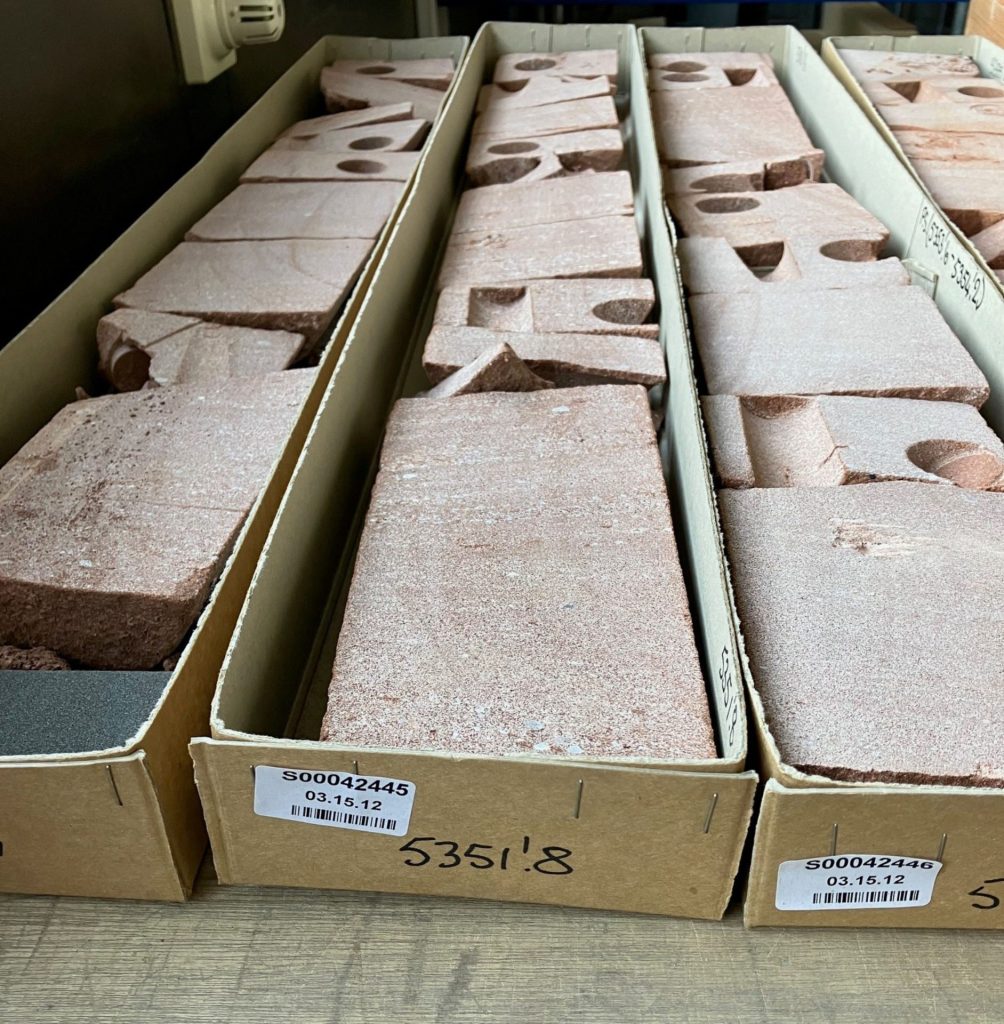
Bunter Sandstone rock cores collected during legacy oil and gas exploration activities are stored at the British Geological Survey’s National Geological Repository where they provide a valuable resource for CO2 storage assessments. Around two kilometres of core were studied thanks to UKCCSRC funding. BGS © UKRI 2026.
We used these data to better characterise a number of aspects, such as:
- The structural configuration of the subsurface to identify the size and extent of the interconnected rock units in the Bunter Sandstone.
- The depositional history of the Bunter Sandstone and its stratigraphic connectivity.
- The impact of post-burial processes on the properties of the reservoir rock materials.
- The extent and efficacy of the overlying sealing rocks.
- The geomechanical effects related to potential pressure increase.
How did you subsequently build on this work?
The initial findings and understanding we developed during the UKCCSRC project enabled us to identify some key research questions and to develop proof of concept. We then sought further funding from other sources to refine these ideas and to implement full interpretation and modelling studies. We received funding from the Industrial Decarbonisation and Innovation Centre (IDRIC) to further evaluate CO2 storage in the Bunter Sandstone. Using geological understanding developed during the UKCCSRC project, we built a three-dimensional geological model and conducted a numerical modelling exercise to simulate the pressure response to CO2 injection based on published industry storage scenarios.
The NERC-funded MOET project then provided an opportunity to disseminate the results more widely through a series of papers and published datasets. We also used the NERC funding to deliver an additional regional study focused on the Röt Halite Member, a halite (rock salt) unit which overlies much of the Bunter Sandstone. The unique properties of halite mean that the Röt Halite potentially provides a highly effective seal which would prevent CO2 from migrating upwards out from the intended storage formation. Understanding the properties and distribution of this rock unit is therefore a key consideration in CCS appraisal studies. In another piece of work, we built on our earlier numerical modelling work by incorporating geomechanical effects, providing insights into the rock deformation behaviour at the regional scale. Studies such as this are important as they provide insights into the likely behaviour of CO2 storage sites, helping to understand storage risks and to develop suitable monitoring strategies. Without access to the UKCCSRC funding, we would not have been in a position to develop strong proposals to fund the additional work required to complete these regional-scale studies.
With the first UK CCS projects in development, how do these regional geological studies fit into the industrial implementation picture?
Industry studies tend to focus on the risks associated with specific carbon storage licences, as required to navigate through the regulatory milestones needed to eventually obtain a permit to store CO2 in the subsurface. The advantage of research projects is that they can focus on the regional picture, independently of the specific needs of any individual carbon storage licence. The expectation is that this will in turn provide the licence operators with the understanding they need to place their own site appraisal studies into an appropriate regional context, while helping those companies and their regulatory agencies to better understand potential regional impacts.
The first Storage Permit for a UK Bunter Sandstone site was issued to the Northern Endurance Partnership (NEP) in December 2024, with the project now in construction with anticipated start-up within the next few years. As the project expands, and other licenced sites mature along their development pathways, the necessity of understanding rock properties and connectivity at the regional scale will be further enhanced.
What comes next?
To meet current climate targets, the UK needs a lot of CO2 storage – which will be challenging to implement given the scale-up required. The Bunter Sandstone is one very large and extensive rock formation that will accommodate some of the CO2, but we will need to develop other rock formations. Several rock units are being considered by industry consortia, but there are some units beneath the North Sea that offer a theoretically very large storage potential, yet remain relatively underexplored to date. Regional geological studies such as those we undertook for the Bunter Sandstone provide an excellent way to explore the challenges that will be faced when seeking to develop these reservoirs. Doing this in a pre-competitive manner through research-focused initiatives will provide stakeholders, including regulators and industries, with valuable information that will help to understand how to most effectively utilise the UK’s storage resources.

Seismic and well data are integrated in a 3D workstation environment to build 3D models for assessments of CO2 storage potential. BGS © UKRI 2026.
At BGS, we have been working towards this by conducting research focused on the Central North Sea, an area with enormous potential for CO2 storage, but not without its challenges. This initiative provides an ideal opportunity to implement the principles, methodologies and understanding developed during the UKCCSRC project.
Published results
Abel, L.E., Williams, J.D.O., Wright, K.A., Randles, T.A., Bridger, P., Morris, H.A., Dodd, T.J.H., Plenderleith, G.E., White, J.C. 2025. Structural controls on pressure communication across the Bunter Sandstone Formation, UK Southern North Sea. Geoenergy, 3, geoenergy2024-027. https://doi.org/10.1144/geoenergy2024-027
Graham, R., Williams, J., Purvis, S., Parsons, R. 2025. Stratigraphic and Sedimentological Evolution of the Bunter Sandstone Formation, UK Southern North Sea: Implications for CCS. Sixth EAGE Global Energy Transition Conference & Exhibition (GET 2025), Oct 2025. https://doi.org/10.3997/2214-4609.202521059
Morris, H.A., Williams, J.D.O., Abel, L.E., Hough, E., Field, L.P., Parsons, R. 2026. Evaluation of the Röt Halite Member as a top seal for carbon dioxide storage in the Southern North Sea. Geoenergy, 4, geoenergy2025-029. https://doi.org/10.1144/geoenergy2025-029
Rushton, J.C., Hannis, S., Pearce, J., Williams, J., Milodowski, A.E. 2025. Diagenetic evolution of the Bunter Sandstone Formation and its controls on reservoir quality: implications for CO2 injectivity and storage. Geoenergy, 3, geoenergy2024-023. https://doi.org/10.1144/geoenergy2024-023
Williams, J.D.O. 2025. Pore pressure data from the Bunter Sandstone Formation, Southern North Sea of the UK Continental Shelf. NERC EDS National Geoscience Data Centre. (Dataset). https://doi.org/10.5285/530ccd12-bfca-4112-b25c-e8c929f74964

Dr Stuart Gilfillan, University of Edinburgh, was awarded UKCCSRC Flexible Funding in 2014 for “Quantifying Residual and Dissolution Trapping in the CO2CRC Otway Injection Site” and in 2018 for “Resolving CO2 trapping and tracking CO2 migration in the Carbon Management Canada Field Research Station, Canada, using inherent tracing tools“. These projects are now being built on with a new grant from NERC’s Pushing The Frontiers scheme for “Enabling CO2 mineralisation through pore to field-scale tracking of carbonate precipitation: INCLUSION”.
Hi Stuart, what issue is your research trying to address?
My key research motivation is assuring the safety and security of CO2 storage, which has been the fundamental theme running through all the research I’ve done to date. The tools we use are geochemical fingerprinting tools and that’s for two things. First, to check what’s happening with the CO2 when it’s underground in the storage reservoir; and second, if it makes an unplanned migration out of the storage site, can we detect it?
I’m quite careful in the wording, because I don’t deem leakage to be the same thing as unplanned migration out of the storage site. What we look at is different sensitivities of different tools to detect that, and then fix it before it becomes a leakage to surface or a major issue. The vast majority of the work I’ve done is about storage security in the reservoir itself.
What exactly is geochemical fingerprinting?
CO2 is made up of carbon and oxygen and the work I’ve done is based on what I term inherent fingerprints – fingerprints that are contained in the CO2 itself. CO2 has different fingerprints – in terms of the carbon and the oxygen, it has different isotopes or variations, so the same element but different mass number, and that’s because of a different number of neutrons in the nucleus. You’ve got carbon-12 and carbon-13, and we’ve also worked a little bit on radiocarbon as well, which is the one people have probably heard about as it’s what archaeologists use for carbon dating.
And then we also have stable isotopes of oxygen, so oxygen 16 and oxygen 18. It’s using those different tools – the carbon-12 and carbon-13 ratio – to differentiate between the different sources of CO2 in the subsurface, those that are anthropogenic (i.e. injected) and those that are natural. One of the things I was involved in, 15 years ago, was an investigation in Canada where there were allegations of leakage from a CCS project and that was based on matching of the carbon isotopes (1).
The other toolbox I use is the noble gases – I’m trained in noble gas geochemistry – and in any injected CO2 or any CO2 in the subsurface, there are trace amounts of noble gases. The noble gases are conservative tracers in the subsurface, and they allow us to fingerprint different sources of CO2. They also enable us to understand what happens to that CO2 in terms of different things acting on it, e.g. dissolution or mineralisation, and we’ve also worked on the residual trapping of the CO2 as well. They’re all different ways of understanding what’s happening to the carbon dioxide when it’s injected underground.
Is the carbon dioxide we inject underground different to what’s naturally there?
It depends. For the most part, the research we’ve done shows that there is a distinct fingerprint for the vast majority of it, and that’s because the combustion process and then the capture process does give it a reasonably unique fingerprint. That is caveated with different things, so different tools can be used for different sources, but some of the work we did, linked with a project that the UKCCSRC funded, was looking at the fingerprints in captured CO2. There were two good papers that came out of that (2 & 3) and we did determine that, for the most part, there are distinct fingerprints in the anthropogenic CO2 compared to the background CO2 underground.
You had two Flexible Funds awards from us – one in 2014 and one in 2018. What did those two awards enable you to do?
 The 2014 project funded work in Australia, looking at a couple of things. The first was noble gas tracers in the subsurface, and enabled us to collaborate with one of the world’s best CO2 injection test sites at Otway in Australia. That project was fantastic to work on, great people and a really nice site set-up. They’ve done some great science there, looking at different aspects of CO2 injection and testing a lot of different tools.
We were able to deploy our tracer tools on residual trapping tests, what’s called a push-pull test. So, they injected CO2 into the reservoir, then followed that up with CO2 saturated water. The idea was to drive the formation underground into residual saturation and then pull the CO2 back out, in order to compare the fingerprint of what was injected and what came out, then determine how much residual trapping had occurred. Again, there were two papers (4 & 5) we published about using oxygen isotopes as the tool in that. We did see changes in those but, given the nature of the test, it was quite quick and piggybacking off something else. We still learned from it and saw that the oxygen isotopes did change on a short-time scale.
Then we followed that up with a couple of experiments (and another paper that I published last year (6)), where the postdoc on the project looked at how fast the CO2 equilibrates with oxygen in the lab, and how the oxygen isotopes change. Off the back of that, there was also a PhD student looking at Australian CO2 fields and the origin of CO2, because a lot of the work I’ve done in the past has been looking at how nature has stored CO2 in the natural CO2 reservoirs, how long they’ve stored CO2 for, and how that CO2 has been stored over geological timescales.

(L) Sascha Serno and Gareth Johnson checking gas levels at CO2CRC Otway site; (R) Stuart Gilfillan measuring gas samples in the geochemistry lab at the CO2CRC Otway site
Did your 2018 project lead off that one or was it different?
Having spent my early career looking at these natural CO2 reservoirs, and then following that up by looking at these test sites, I guess I became a specialist in working on test sites. It was a good opportunity to travel and I also really enjoyed the site work and doing the hands-on stuff. With the 2018 project in Canada, we got invited out because we’d been involved in a study previously in Canada on leakage allegations.
We went to a test site that, at the time, wasn’t really constructed. What’s been fundamental in a lot of the work we’ve done, or what’s caused problems in the past, is not having great baselines. You need to know what your geochemical baseline is so you can do a comparison of before and after. Because the Canadian site was still being developed, we were able to collect a number of different samples from different wells which gave us a really good understanding of what the baseline was.

Steph Flude and Stuart Gilfillan at the Field Research Station, Canada
Interestingly, as well, they were injecting captured CO2, commercial CO2, and one of the things we found in that study was enrichment in the krypton and the xenon in the noble gas fingerprint (7). That could be quite a sensitive tracer for the injected CO2, and the great thing about that is it’s not something that needs to be added, it’s already present.
That’s presumably because captured carbon has been processed to some degree?
It is. Usually, in terms of noble gas fingerprinting, it’s generally solubility capture tools that are used, like amine solvents. They concentrate up the heavier noble gases, particularly xenon, because it’s actually very soluble. So that also gets stripped out and enriched in the captured CO2. The other good thing is that there’s very little xenon in the subsurface, so that’s actually something we’ll need to work on and think about a bit more, to fully understand how we can use this to track the injected CO2.
How did those projects lead on to the big one you’ve got now with NERC – Pushing The Frontiers?
As I said, part of the research I’d been doing had been hands-on work on the different CO2 test sites. Carbfix came on the radar – they’ve been doing their injection tests since about 2012, 2013 – and had seen some of the work we’d done in the past, particularly on the natural CO2 reservoirs. They thought it would be really good to deploy this in Iceland and that led to a PhD student, Chris Holdsworth, being partially funded by Carbfix.
Off the back of that, they learned through his PhD project how to do things and what the setup was. I’d worked a lot on natural gas fields, hydrocarbon fields and CO2 reservoirs, but geothermal fields are a whole other kettle of fish in terms of complexity, different fluids and interesting sampling. We developed, then used, all the different tools – geochemical, fingerprinting – and applied them to what Carbfix were doing, trying to understand if we can track the mineralisation that they expect to be happening underground and find out if we can actually see that in the different fingerprinting tools.

(L) Chris Holdsworth at Nesjavellir; (R) Stuart Gilfillan and Chris Holdsworth sampling at Hellisheidi
In conventional CCS, and some of the early work I did showed that, even in the natural CO2 reservoirs that have stored CO2 for millions of years, we don’t actually see a lot of evidence for mineralisation of that CO2. That’s simply because in a sandstone rock or carbonate reservoir, there’s not a lot for the CO2 to react with, like iron, magnesium or calcium. However, in Iceland, in these basaltic rocks where Carbfix are injecting the CO2, a couple of things happen. First of all, the CO2 makes carbonic acid underground, which then dissolves some of the rock and releases calcium, magnesium and iron, particularly. They then combine with the CO2 to mineralise and form new carbonate minerals (8).
What we worked on way back, when I started publishing in the first PhD study, was distinguishing between CO2 dissolution and CO2 mineralisation in the subsurface. That work showed that we weren’t seeing evidence of mineralisation on a big scale in the natural reservoirs, but now, taking the same methods, we can use them to say that we are seeing significant amounts of mineralisation happening in the subsurface in Iceland. That paper (9) came out earlier this year and shows that we can track the mineralisation that’s happening with Carbfix, and it aligns with previous estimates as well.
So is the focus of this new project to take all the skills and learning, but then use them in a different environment?
Yeah, I guess one of the things that’s always intrigued me as a researcher is doing things that are novel and challenging, so the way I see it, with what I term conventional CCS, is that that’s really getting towards the deployment stage. In terms of the science, it’s not like there isn’t more to do, but I think a lot of the fundamental science has already been done, and we’ve been working on that for quite a while. So, this was looking to see, right, we’ve got these tools, but can we now apply these to a different problem, knowing that they should work? It’s never quite as straightforward or as easy as you think it will be, and certainly the fieldwork has been quite challenging at times, but fundamentally the science is robust. We’ve tested that in a variety of different places, and we’ve now tested and developed that in Iceland with Carbfix.
We’ve got Chris’s main paper from his PhD now published (9) and a patent application from that, then we’ve just done another one on the geothermal fluid chemistry and understanding a bit more about that. We’re also developing the more detailed time series of the mineralisation and seeing how that’s changing. One of the concerns with CO2 mineralisation is how long can you keep doing it for?
The goal of this project is to show that this is a useable toolkit – these inherent tracers are tools that you can actually use to monitor, report and verify CO2 mineralisation. One of the things that’s key for how Carbfix operate, and particularly their combination with Climeworks, is that they’re getting carbon credits for the CO2 that they’re locking away underground. What we’re trying to do here is develop and help them to verify that that CO2 is being disposed of and permanently stored underground.
Papers
1. Using noble gas fingerprints at the Kerr Farm to assess CO2 leakage allegations linked to the Weyburn-Midale CO2 monitoring and storage project, International Journal of Greenhouse Gas Control, August 2017
2. Inherent Tracers for Carbon Capture and Storage in Sedimentary Formations: Composition and Applications, Environmental Science and Technology, July 2016
3. The inherent tracer fingerprint of captured CO2, International Journal of Greenhouse Gas Control, October 2017
4. Using oxygen isotopes to quantitatively assess residual CO2 saturation during the CO2CRC Otway Stage 2B Extension residual saturation test, International Journal of Greenhouse Gas Control, September 2016
5. Oxygen isotopes as a tool to quantify reservoir-scale CO2 pore-space saturation, International Journal of Greenhouse Gas Control, August 2017
6. Constraining O isotope equilibrium exchange between CO2 and water during fluid cycling in a closed system, International Journal of Greenhouse Gas Control, February 2025
7. Multi-Isotope Geochemical Baseline Study of the Carbon Management Canada Research Institutes CCS Field Research Station (Alberta, Canada), Prior to CO2 Injection, Earth Science, Systems and Society, January 2023
8. Reconstructing the temperature and origin of CO2 mineralisation in CarbFix calcite using clumped, carbon and oxygen isotopes, Applied Geochemistry, February 2024
9. Monitoring CO2 mineralisation and dissolution at CarbFix2 using inherent isotopes of CO2, H2O and noble gases, International Journal of Greenhouse Gas Control, March 2026
The UK Carbon Capture and Storage Research Community (UKCCSRC) is supported by the Engineering and Physical Sciences Research Council (EPSRC) as part of the UK Research and Innovation (UKRI) Energy Programme.


The mission of the UKCCSRC is to ensure that carbon capture and storage (CCS) plays an effective role in helping the UK achieve net-zero greenhouse gas emissions by 2050.
Location
D03 Ella Armitage Building
University of Sheffield
40 Leavygreave Road
Sheffield
S3 7RD
UK
Social
